








Yumbe turns to climate-smart solutions to restore forests lost to refugee settlement expansion.
Yumbe is writing a different story, one of climate-smart restoration, large-scale reforestation, multi-agency collaboration, and a renewed effort to reclaim the green cover that once defined the district




Yumbe turns to climate-smart solutions to restore forests lost to refugee settlement expansion. photo by Robert Mone
By Robert Mone
Yumbe District
When the dusty plains of Yumbe opened to receive thousands of refugees fleeing the brutal conflicts in South Sudan and the Democratic Republic of Congo nearly a decade ago, the district, a once-lush landscape of communal grazing fields, natural woodland, and scattered homesteads, had little time to prepare for what would follow. The establishment of Bidibidi Refugee Settlement in 2016, now one of the world’s largest refugee settlements, came with an enormous environmental price tag: trees felled for shelter, fuel, and farmland; fragile ecosystems stripped bare; and community tensions ignited over dwindling natural resources.
Today, however, Yumbe is writing a different story, one of climate-smart restoration, large-scale reforestation, multi-agency collaboration, and a renewed effort to reclaim the green cover that once defined the district. Government agencies, the UN Refugee Agency (UNHCR), development partners, and private actors have converged on Yumbe with one common goal: rebuilding its forests, one seedling at a time.
A Decade of Escalating Forest Loss
In 2010, Yumbe District covered a land area of 2,393 square kilometers, with approximately 250 square kilometers later allocated to accommodate the five zones of Bidibidi Refugee Settlement. At that time, satellite assessments estimated the district’s total tree cover at 63,800 hectares. But with the rapid arrival of refugees today, more than 208,000 of Yumbe’s estimated 1,000,000 residents are refugees and asylum seekers the pressure on natural resources intensified sharply.
By 2020, Yumbe’s tree cover had fallen to 58,500 hectares, and by 2024 it had reached a worrying low of just 50,500 hectares. Data from Global Forest Watch reveals that from 2001 to 2024 alone, the district lost about 8,500 hectares of tree cover. A staggering 97% of this degradation has occurred since the settlement was created.
Natural forests now account for just 25% of the district’s cover, significantly reduced from earlier decades. While agriculture caused an estimated 7,900 hectares of loss over 20 years, and settlement infrastructure another 250 hectares, Bidibidi’s rapid transformation of land for temporary homes, communal spaces, and livelihoods remains the biggest driver of deforestation in the area.
Lives at the Center of the Crisis
For many refugee families, fuelwood has been both a necessity and a source of deep vulnerability. Firewood is their primary source of cooking energy, yet accessing it has become increasingly dangerous, especially for women.
Margret Poni, a 57-year-old refugee from South Sudan living in Zone III of Bidibidi, recalls the early days of the settlement with a mixture of relief and sorrow.
“When we first arrived in 2016, we could easily collect firewood around our homes,” she says. “Now I walk more than ten kilometers to find wood, sometimes as far as Iyete. The distance is hard, and the hostility from some members of the host community makes it even harder.”
Her situation grew worse after food rations were reduced. She would sell a portion of the distributed food to buy firewood from local communities, but after cuts in food aid, even that option disappeared. Today, she sometimes burns cassava stems to cook for the children under her care.
The risks extend beyond exhaustion. According to Emmanuel Abade, a community focal point for the International Rescue Committee in Zone III, there have been “isolated but worrying cases” of women being assaulted or raped while collecting firewood in nearby communities.
“Refugee women sometimes fear approaching landlords formally due to language barriers or personal conflicts, so they enter bushland informally,” Abade explains. “That has exposed them to harassment.”
The environmental strain, social tensions, and personal dangers highlight the urgency of finding sustainable solutions for both host and refugee communities.
A New Path: Climate-Smart Restoration
Recognizing the severity of the crisis, the Government of Uganda and various UN agencies—chief among them UNHCR and the Food and Agriculture Organization (FAO)—developed the Forest Landscape Management Plan for Bidibidi (2023–2028). The plan coordinates approaches to managing natural resources through agroforestry, woodlot establishment, restoration of degraded land, and community involvement.
This strategy builds on earlier interventions that began in 2019, bringing together the Office of the Prime Minister, the Ministry of Water and Environment, the Yumbe District Local Government, refugee welfare councils, and local landlords.
One of the most significant boosts came in 2021, when Uganda secured USD 178.2 million from the World Bank under the Investing in Forests and Protected Areas for Climate-Smart Development (IFPA-CD) project. Implemented by the Ministry of Water and Environment in partnership with the Uganda Wildlife Authority and National Forestry Authority, the six-year project aims to enhance forest and protected area management while improving community livelihoods.
According to the Ministry, the project includes provisions for distributing firewood to vulnerable refugee households covering 8,704 households consisting of the elderly, persons with disabilities, chronically ill persons, and child-headed families.
“Planting Trees is Good, Growing Them Is Better.”
Margaret Athieno Mwebesa, Uganda’s Commissioner for Climate Change and national focal point for the UN Framework Convention on Climate Change, has repeatedly emphasized the scale of environmental destruction around refugee settlements.
“If you look at satellite imagery, Bidibidi stands out as one of the most degraded landscapes globally,” she notes. “While planting trees is important, growing those trees is even more essential. The full value chain from seedling production to care and monitoring needs much stronger support.”
Athieno believes IFPA-CD is vital in reversing degradation around Yumbe by promoting agroforestry, sustainable woodlots, and climate-smart agricultural systems. But she warns that without local ownership, restoration will lag.
Barriers to Forest Recovery
Despite enormous investments, forest recovery has not been easy. Wildfires, often set by local hunters in search of wild animals, continue to destroy extensive areas of young trees. Wandering livestock trample seedlings, while prolonged dry spells, especially between December and April, lower survival rates dramatically.
Habib Sebbi Edema, Yumbe’s District Forest Range Extension Officer, says restoration rates have stagnated at 45–50%, far below the district’s 80% target.
“Host communities have not fully embraced ownership of restoration efforts,” he says. “The land occupied by the settlement was previously grazing land. It was green. But since refugees arrived, the area moved into a ‘red zone’ of degradation.”
Edema adds that earlier programs like the Development Response to Displacement Impacts Project (DRDIP), along with support from Dan Church Aid and Save the Children, have significantly contributed to reforesting the district. Yet challenges remain persistent and complex.
Milestones and Success Stories
Despite these setbacks, Yumbe has made significant gains in recent years. UNHCR alone has planted 4.45 million seedlings since 2019 and established 5,924 hectares of woodlots. In 2025, the agency raised 591,664 seedlings and distributed 491,469, with an impressive 80% survival rate.
Across the West Nile region, including Adjumani, Moyo, Obongi, and Madi-Okollo, UNHCR supports nearly half a million refugees. According to Paul Kenya, head of UNHCR’s sub-office in Yumbe, Uganda’s open-door refugee policy and settlement model encourage coexistence, but they demand a deeper focus on environmental recovery.
On November 13, UNHCR launched the Refugee Environmental Protection Fund, a 10-year initiative aimed at restoring 100,000 hectares of degraded land across Uganda and Rwanda while expanding clean energy access to a million people.
In Uganda, the fund will restore 6,000 hectares across Bidibidi and Kyangwali settlements, create thousands of green jobs, strengthen food and water systems, and cut more than 200,000 tonnes of CO₂ annually.
Shea Seedlings operated by Shea Nuts and Natural Oils Conservation Limited in Midigo Town Council
Private Sector Joins the Restoration Effort
Beyond government and humanitarian actors, private companies have entered the landscape restoration space with innovative approaches. One notable example is Shea Nuts and Natural Oils Conservation Limited (SNNOC), which runs a one-acre shea nursery in Midigo Town Council.
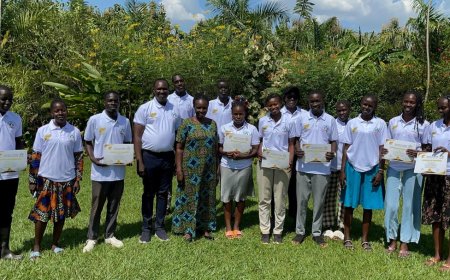
SNNOC is spearheading the restoration of traditional shea trees across the West Nile through youth football tournaments, art and craft programs, and cooperative group formation. The company is currently raising 50,000 seedlings for distribution in the next rainy season and has registered 11 cooperatives, each with at least 50 members.
General Manager of Shea Nuts and Natural Oils Conservation Limited, George Akuma notes that the company supports 14 satellite nurseries across Yumbe and Moyo districts, each producing 4,000 seedlings. However, he highlights challenges such as a lack of land for demonstration plots, inadequate water supply, the absence of a greenhouse, and transportation difficulties for extension workers.
District-Level Commitment
The Yumbe District Local Government continues to play a vital role by distributing between 45,000 and 70,000 seedlings annually to willing farmers. Over six years, this translates to 270,000–420,000 seedlings, enough to cover between 600 and 933 acres of land.
While these numbers are promising, the district stresses that long-term success depends on consistent community engagement, improved climate resilience mechanisms, and stronger collaboration with refugee leaders.
Looking Ahead
Yumbe is slowly reclaiming parts of its former green identity. Bare hillsides are sprouting seedlings; community cooperatives are learning agroforestry techniques; host and refugee families are experimenting with cleaner cooking solutions that reduce firewood dependence. But the work is far from over.
The district stands at a crucial intersection: balancing humanitarian responsibilities with environmental sustainability, and aligning community needs with long-term restoration goals.
If current initiatives continue—supported by technology, policy, local ownership, and climate-smart approaches—Yumbe may well become a national example of how regions hosting large refugee populations can restore ecosystems while strengthening coexistence and resilience.
What's Your Reaction?