















From Farming for Food to Farming as a Business: How Ayac Smart Farm, Olobo Is Transforming Lives In Lango

From Farming for Food to Farming as a Business: How Ayac Smart Farm, Olobo Is Transforming Lives In Lango
LIRA DISTRICT, UGANDA — For more than three decades, Patrick Olobo depended largely on traditional subsistence farming to support his family.
Like many smallholder farmers in northern Uganda, he grew crops such as cassava and millet primarily to feed his household. But despite years of hard work, the returns were limited, leaving him with little income to meet the growing needs of his family.
Today, Olobo is telling a different story.
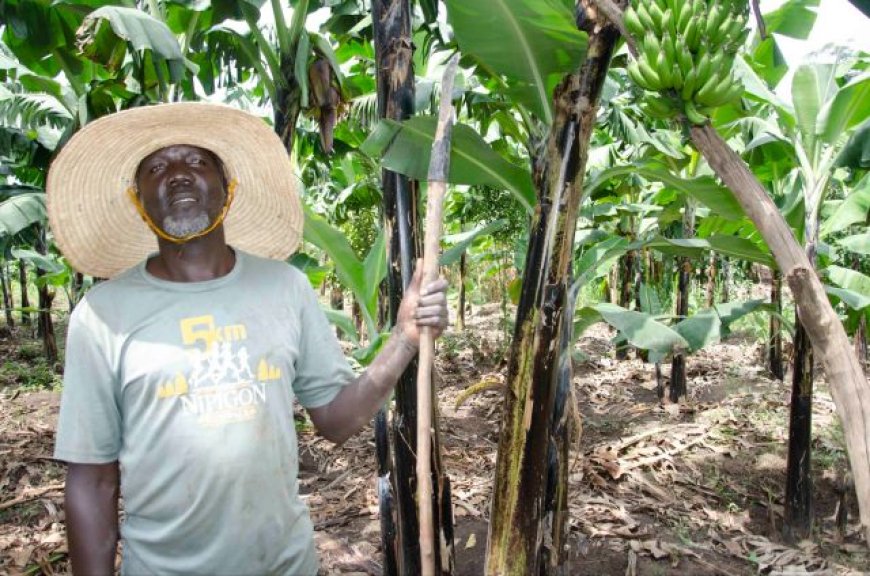
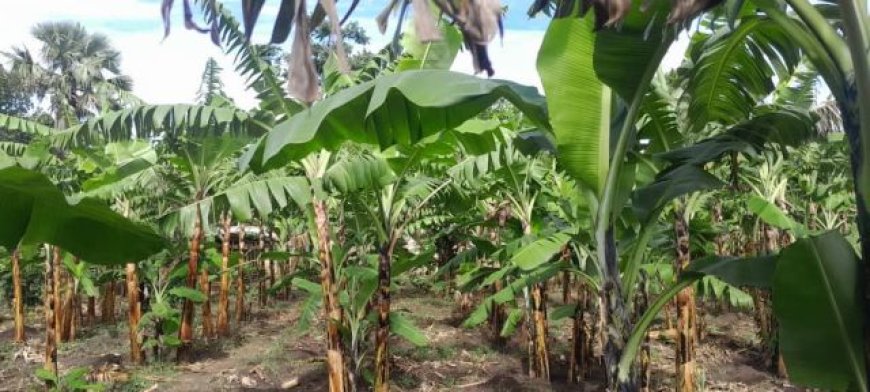
On his farm in Ayac Ward, Amac Town Council in Lira District, rows of banana plants have replaced much of the subsistence farming that once defined his agricultural life. What began as a personal decision to change his farming approach has gradually developed into a commercial enterprise supporting his family, creating jobs and supplying food to the surrounding community.
Olobo's journey reflects a broader challenge facing agricultural communities across Africa: how to move from farming primarily for household consumption to agriculture that generates reliable income, employment and economic opportunities.
In Uganda, President Yoweri Kaguta Museveni has frequently promoted the transition from subsistence agriculture—often described locally as **“pur me cem,” meaning farming for food—to commercial farming**, where farmers produce for markets and income.
For Olobo, that transition has been life-changing.
Speaking during a visit to his farm ( Ayac Smart Farm) on Thursday, Olobo explained that his fortunes began to change after he decided to look at farming not only as a way of producing food, but also as a business.
“I can tell you now that because of farming, I have travelled to places where I never thought I would reach, even with my level of education as a teacher,” Olobo said.
One of the most important opportunities came when he was selected among outstanding farmers by New Vision, Uganda's leading newspaper, allowing him to travel to the Netherlands for an agricultural learning and exchange programme.
The experience exposed him to commercial farming systems, modern agricultural practices and value addition.
“I was lucky to be among the best farmers chosen by New Vision. I went to the Netherlands, where I learnt and exchanged experiences on commercial farming and value addition,” he recalled.
For Olobo, the international exposure changed the way he viewed agriculture.
He returned home determined to apply what he had learnt to his own farm.
Turning Recognition Into Investment
Rather than treating the recognition simply as an achievement, Olobo used part of the prize money he received to invest in his farm.
He installed a water system and is working towards establishing irrigation to reduce his dependence on rainfall.
For a farmer operating in a region where prolonged dry spells can affect agricultural production, reliable access to water could make a significant difference to productivity.
Olobo says his ambition is to expand the farm and strengthen its capacity to produce throughout the year.
However, like many smallholder commercial farmers, he says access to adequate capital remains one of the major challenges limiting expansion.
Bananas Become a Business
Bananas, particularly matooke, have become the backbone of Olobo's commercial enterprise.
His plantation supplies bananas to consumers in and around Lira, while customers also visit the farm to purchase produce directly.
During our visit, customers could be seen entering and leaving the farm. At one point, Olobo had to pause the interview to attend to customers before returning to continue the conversation.
For him, those daily transactions are evidence that commercial farming can create a dependable source of income.
The proceeds have enabled him to support his family and contribute to the education of his children.
He also views the farm as part of the community's food system, supplying matooke to households and other consumers.
Meeting Northern Uganda's Demand for Matooke
Matooke is a major component of meals in many Ugandan households, including communities across northern Uganda.
It is also increasingly found on menus in hotels, restaurants and institutions in the region.
Yet a significant proportion of the bananas consumed in northern Uganda can come from outside the region, creating an opportunity for local farmers who can produce consistently and meet market demand.
Olobo believes this gap presents an opportunity for farmers in Lira and neighbouring districts to expand commercial banana production.
He wants his farm to become part of a stronger local supply chain in which farmers produce for nearby markets rather than depending heavily on produce transported from distant regions.
Creating Jobs for Young People
Olobo's impact extends beyond his own household.
His farm employs young people, some of whom work as farm managers and workers responsible for maintaining the banana plantation.
But Olobo is doing more than providing employment.
He is also training young people in banana production—from planting and plantation management to harvesting.
The initiative is particularly significant in a region where many young people struggle to find formal employment.
Olobo believes agriculture can become an attractive career and business opportunity if young people are given practical knowledge, access to land, financing and markets.
The farmer has also started distributing banana suckers to other farmers while sharing his experience in plantation management.
His intention is to see more households establish productive banana farms.
By sharing planting materials and practical knowledge, Olobo hopes to encourage a wider shift towards commercial agriculture within the community.
He believes that successful farmers have a responsibility to help others learn from their experiences.
From Classroom Teacher to Agricultural Trainer
Before becoming known for his commercial farming, Olobo worked as a secondary school teacher.
Today, he is applying the same teaching skills he acquired in the classroom to agriculture.
He trains farmers and young people in different aspects of farming, explaining practical techniques and encouraging them to treat agriculture as a business.
For Olobo, the transition from teacher to farmer has not meant abandoning education.
Instead, he has taken the classroom into the farm.
His plantation has become a practical learning space where people can observe how commercial banana farming is organised.
Looking Beyond Fresh Bananas
Olobo's ambitions do not stop at producing and selling fresh bananas.
He is exploring opportunities in value addition , including the possibility of producing banana-based beverages and porridge flour.
He says he has already conducted preliminary research into these products and is now looking for resources and investment to develop the ideas further.
Value addition could potentially allow farmers to earn more from their produce while reducing losses associated with bananas that cannot be sold fresh.
It could also create additional employment opportunities through processing, packaging, transportation and marketing.
A Bigger Agricultural Picture
Olobo's experience highlights a wider issue facing African agriculture.
Across the continent, millions of smallholder farmers produce food but struggle to turn agriculture into a reliable and profitable business because of limited access to finance, irrigation, technology, storage, processing facilities and markets.
The challenge is particularly important as Africa's population continues to grow and demand for food increases.
Agricultural transformation therefore requires more than simply encouraging farmers to produce more. It also requires stronger links between farmers, markets, financial institutions, extension services, processors and consumers.
Olobo's story demonstrates what can happen when a farmer gains exposure to new ideas and begins investing in productivity and markets.
#A Farmer Still Dreaming Bigger
Despite his achievements, Olobo says his journey is far from complete.
He wants to expand his banana plantation, improve irrigation, increase production, train more farmers and eventually establish value-addition enterprises.
His story is therefore not simply about bananas.
It is about changing the perception of agriculture—from a struggle for survival to a potential pathway to economic independence.
From a farmer who once relied mainly on cassava and millet for household survival, Olobo has built a commercial banana enterprise capable of supporting his family, creating employment, supplying food and sharing knowledge with other farmers.
As he walks through his plantation, his message to young people and fellow farmers is simple: agriculture can be more than a way to survive.
With knowledge, investment, innovation and access to markets, farming can become a business—and a source of dignity, opportunity and transformation.
What's Your Reaction?