



Alur Appeals for Restoration of Historic Palace into Cultural Museum


By Mike Rwothomio
The Alur Kingdom has formally appealed for the restoration and transformation of its old palace into a modern royal museum dedicated to cultural tourism, education, research, and the preservation of ancestral heritage.
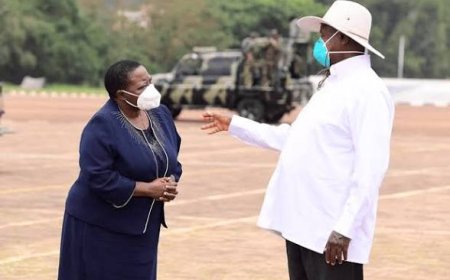
The appeal was made during the visit of Senior Presidential Advisor on Tourism, Ms. Lillian Ajarova, renowned project creator of the Race the Nile Cycling Event on Wednesday, June 10, 2026.
Ajarova was conducting a field assessment of the forthcoming cycling route that will traverse all 13 districts of the West Nile sub-region. She was accompanied by Mr. Isaac Mulindwa Jr, Events Manager of WUZA Ltd Kampala, and Mr. Adriko Michael of the Arua-based West Nile Cycling Club.
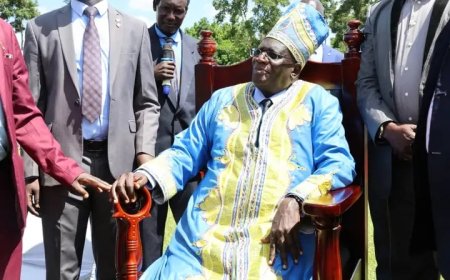
Prime Minister of the Alur Kingdom, Prince Lawrence Opar Angala, warmly received the delegation on behalf of Alur King His Majesty Ubimu Phillip Rauni Ularker III, and urged Ms. Ajarova to champion the restoration project at the highest levels.
"The old palace building was constructed by Rwoth Jalusiga Rauni II, who reigned as Ubimu (King) of Alur," Prince Opar explained. "He ascended to power in 1941 after succeeding his father Rwoth Amula Jobi I and passed on in 1978."
Ms. Ajarova, former Executive Director of the Uganda Tourism Board, was given a guided tour of the historic stone-walled palace, gaining firsthand insight into its significance in the rich history of the Alur Kingdom.
The kingdom encompasses 56 chiefdoms in Uganda and 8 in the Democratic Republic of Congo, to which millions of subjects across the region pay allegiance to His Majesty Ubimu Phillip Rauni Olarker III.
The Senior Presidential Advisor pledged to link the Kingdom with the Acting Commissioner of Museums and Monuments under the Ministry of Tourism, Wildlife and Antiquities.
This connection aims to secure technical and financial support for restoring and expanding the old palace at Kal Atyak Winam into a state-of-the-art royal museum that will serve as a centre for research, history, cultural preservation, and tourism.
The old palace has remained largely unrenovated since its construction. In 2018, His Majesty Ubimu Phillip Olarker Rauni III invited H.E. President Yoweri Museveni to lay a foundation stone, signalling strong government backing for the project to preserve royal artefacts and promote cultural education.
This initiative aligns with the Alur Kingdom’s broader efforts to document and safeguard its cultural artefacts, norms, indigenous knowledge, and technologies. Many valuable items have deteriorated due to inadequate storage and conservation, underscoring the urgency of proper preservation.
The move mirrors recent positive steps within the Kingdom.
Jupa Kubi Chiefdom has embarked on constructing a modern mausoleum at the grave of its founder, Rwoth Kubi, to honour ancestral legacy and seek recognition as a key cultural site.
Similarly, the Palara Clan of Warr-Palara Chiefdom in the DRC is renovating their pre-colonial ancestor’s grave and building a mausoleum in Erussi, Nebbi District.
Both projects seek to honour ancestral spirits, restore sacred sites, and promote them for education, tourism, and future generations.
Prince Lawrence Opar Angala emphasized that these efforts aim to revive and protect thousands of Alur cultural artefacts that risk extinction, ensuring they are preserved for posterity.
The initiative is consistent with national objectives. According to the Ministry of Tourism, Wildlife and Antiquities, over 600 cultural heritage sites and monuments have been designated, with 56 identified as nationally significant and requiring urgent conservation. It also aligns with the Uganda National Council for Science and Technology (UNCST) mandate under Section 4(b) of the UNCST Act to promote indigenous science, technology, knowledge transfer, and local innovations.
In a related development in 2024, the Uganda Museum in Kampala celebrated the return of 39 artefacts repatriated from the University of Cambridge’s Museum of Archaeology and Anthropology. These items, taken during the colonial era in the 1890s and early 1900s, highlight the growing national focus on reclaiming and honouring cultural heritage.
The old palace building was constructed by Rwoth Jalusiga Rauni II, who became the King (Ubimu) of the Alur in 1941 after succeeding his father, Rwoth Amula Jobi I. He reigned until his death in 1978. The palace, built in 1962, remains an important historical landmark of the Alur Kingdom.
What's Your Reaction?