

















Barrister Peter Magomu Mashate Explains Why Presidential Rule by Decree Is Unconstitutional Under Uganda’s 1995 Constitution


ANALYSIS
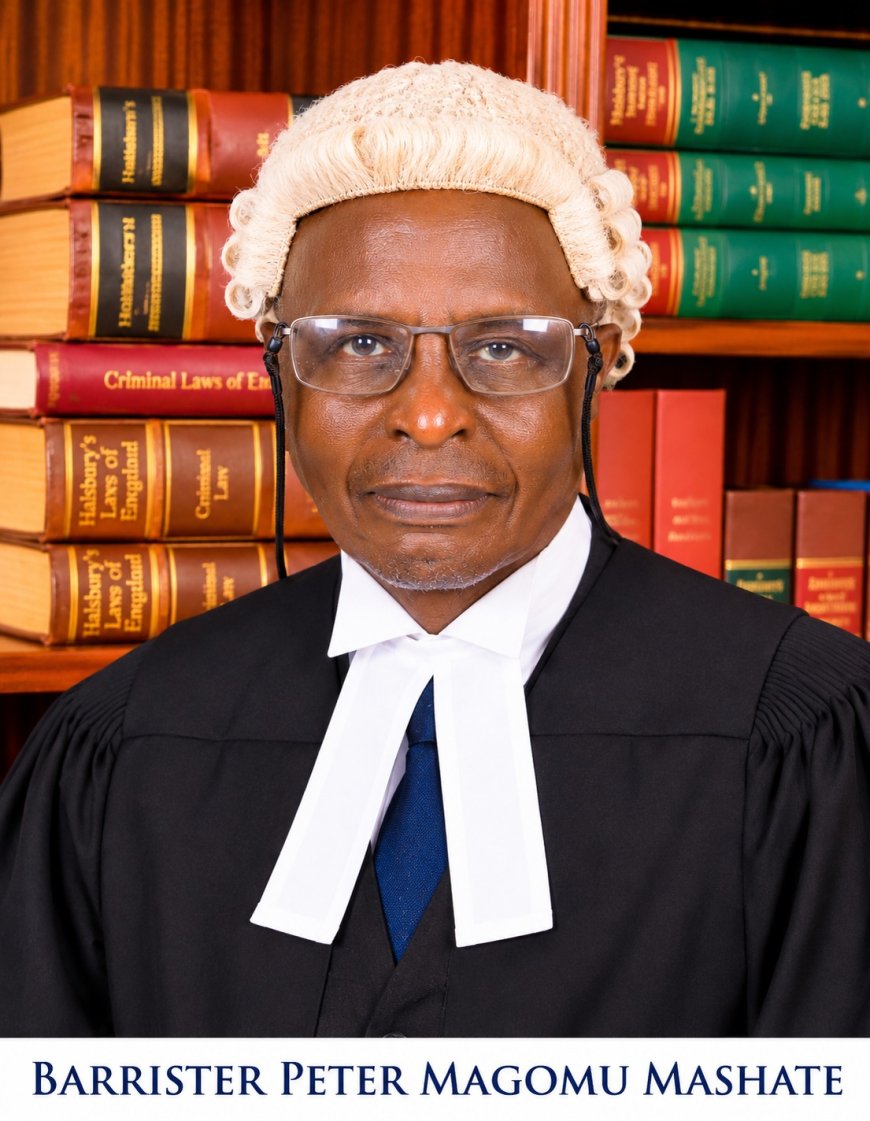
BY BARRISTER PETER MAGOMU MASHATE
Whenever discussions emerge in Uganda concerning presidential directives, ministerial statutory instruments or executive orders, I am reminded of one important constitutional question: at what point does legitimate executive administration cross the line into unconstitutional rule by decree?
As a constitutional and human rights barrister-at-law, I believe that understanding Uganda’s current governance system requires us to examine the country's political and constitutional history.
The practice of formal rule by decree in Uganda can be traced back to February 1966, with its most absolute and militarised form established on January 25, 1971. Its legal foundation was ultimately dismantled on October 8, 1995, following the promulgation of the current Constitution.
Throughout these three turbulent decades, executive rule without meaningful legislative oversight passed through several political stages before being fundamentally rejected by Uganda’s modern constitutional framework.
The Historical Development of Executive Rule by Decree
I locate the beginnings of rule by decree in the period between February 1966 and January 1971.
During the 1966 Mengo Crisis, Prime Minister Milton Obote suspended the 1962 Independence Constitution, concentrated state authority in his hands and introduced the interim "Pigeonhole" Constitution without subjecting it to parliamentary debate.
Although the 1967 Republican Constitution subsequently reinstated a Parliament in name, the government continued relying extensively on emergency powers and executive decrees to exercise authority.
However, fully institutionalised rule by decree emerged on February 2, 1971, shortly after Major General Idi Amin seized power through a military coup. Under Legal Notice No. 1 of 1971, Amin dissolved Parliament, suspended constitutional supremacy and concentrated both legislative and executive authority exclusively in the presidency.
After Amin's removal in 1979, Uganda entered another transitional period lasting until 1995. Successive administrations, including the Uganda National Liberation Front, the 1980 Military Commission, Tito Okello's military government and the early National Resistance Army/Movement administration through Legal Notice or Proclamation No. 1 of 1986, continued governing through proclamations, decrees and ordinances while important provisions of the 1967 Constitution remained suspended.
This transitional period came to a definitive end on October 8, 1995, when the promulgation of the 1995 Constitution restored constitutional supremacy and established Parliament's authority within the country's democratic governance structure.
The Promised Benefits Versus the Destructive Consequences
Every government that embraced rule by decree presented it as an unavoidable response to political deadlock, insecurity or the urgent need to restore national stability. However, an objective examination of Uganda's history demonstrates that these supposed solutions repeatedly produced consequences more damaging than the problems they claimed to address.
First, authoritarian governments defended decrees on the grounds that they allowed decisions to be made quickly, without delays associated with parliamentary discussions, particularly during security emergencies. In practice, however, this approach encouraged arbitrary administration and allowed laws to be introduced according to personal preferences, including restrictions on mini-skirts and the expulsion of citizens, without meaningful public scrutiny.
Second, proponents of executive rule argued that concentrated presidential authority could resolve political disagreements and divisions between federal kingdoms, particularly Buganda, and the central government. Instead, abandoning negotiated political settlements weakened institutional legitimacy and intensified sectarian tensions and resentment.
Third, executive decrees were presented as effective instruments for transforming the economy and implementing rapid nationalisation policies, particularly during the 1972 "Economic War." Rather than improving economic opportunities for Ugandans, unpredictable government decisions destroyed investor confidence, weakened domestic production and contributed to economic collapse and hyperinflation.
Finally, transitional administrations in 1979 and 1986 justified their reliance on decrees as necessary measures for restoring stability when Parliament was not sitting. Nevertheless, such measures frequently undermined the authority of ordinary civil courts, protected government officials from accountability, weakened judicial independence and created an environment in which extrajudicial violence could become normalised.
Why Rule by Law Must Never Be Confused With the Rule of Law
From a jurisprudential perspective, I consider it essential to distinguish between the concept of the "Rule of Law" and the practice commonly described as "rule by law."
Rule by decree cannot be equated with the Rule of Law. Rather, it represents rule by law, where an individual's personal authority is presented through formal legal documents and instruments.
Under rule by law, a leader employs legal instruments such as decrees and legal notices to impose personal decisions and political preferences. Ordinary citizens are expected to obey the law, while the person exercising power effectively places himself above it, retaining the ability to change, disregard or suspend established rules whenever necessary.
The genuine Rule of Law, on the other hand, is founded on A.V. Dicey's classical constitutional doctrine, which informs Ugandan jurisprudence. Its central requirement is that nobody, regardless of position or political authority, should be above the law. It further demands open and representative legislative processes, supported by an independent judiciary capable of interpreting and enforcing the law.
Even where a president issues a decree with seemingly beneficial intentions or produces a positive social outcome, the absence of democratic legitimacy, proper lawmaking procedures and institutional accountability remains fundamentally inconsistent with the Rule of Law.
Why Rule by Decree Cannot Coexist With the 1995 Constitution
Uganda's 1995 Constitution was deliberately designed to prevent the return of unrestricted executive authority. Its constitutional structure directly addresses the dangers associated with governing through presidential fiat and establishes four important safeguards.
Constitutional Supremacy (Article 2): Any decree, executive order or government action that contradicts the Constitution is unconstitutional and therefore null and void.
Prohibition of Unconstitutional Takeovers (Article 3): Any attempt to suspend, overthrow or abrogate the Constitution is treated as treason. Citizens are also constitutionally required to resist such unconstitutional attempts through lawful means.
Exclusive Legislative Authority (Article 79): Parliament alone possesses the authority to enact primary legislation for the peace, order, development and good governance of Uganda.
Strict Constitutional Restrictions During Emergencies (Article 110): Even when a state of emergency is declared, presidential powers remain subject to strict constitutional limitations. Such powers are time-bound, require prompt parliamentary approval and cannot be used to suspend non-derogable rights protected under Article 44, including habeas corpus and freedom from torture.
How Uganda's Courts Protect Constitutional Boundaries
Although institutions such as the Uganda Law Society rightly continue examining possible cases of executive overreach, I draw considerable encouragement from the manner in which Uganda's superior courts have repeatedly defended the constitutional distinction between legitimate executive administration and unconstitutional government by decree.
In Nakasero Market Sitting Tenants (NAMASITE) Ltd v. Nakasero Market Sitting Vendors & Traders Ltd, the Court of Appeal made it clear that a presidential directive unsupported by an Act of Parliament cannot acquire the force of law. The same constitutional principle was reflected in Horizon Coaches Ltd v. Edward Rurangaranga.
During the COVID-19 pandemic, the Constitutional Court, in Male Mabirizi v. Attorney General, further explained that presidential directives acquired legal force because the Minister of Health subsequently converted them into formal statutory instruments under the Public Health Act.
In another important decision, Uganda Court Bailiffs Association Ltd v. Attorney General, the Constitutional Court invalidated executive directives that required court orders to obtain clearance from Resident District Commissioners or security officials before they could be enforced.
Likewise, in Muwanga Kivumbi v. Attorney General and Kwizera v. Attorney General, the courts reinforced the principle that delegated legislation must remain within the authority granted by its parent Acts and cannot exceed those legal boundaries (ultra vires). They also reaffirmed that executive policy directives cannot independently acquire the force of law without proper parliamentary authorisation.
Executive dominance may occasionally challenge the limits of Uganda's constitutional framework, but the position established through our jurisprudence remains clear: a presidential letter or ministerial instrument does not automatically become a decree with the force of law.
Under the 1995 Constitution, the practice of rule by decree has no legitimate place in Uganda's constitutional order. The era in which individual rulers could substitute personal authority for constitutional governance was brought to an end, and its return cannot be reconciled with the country's supreme law.
THE WRITER IS LONDON-BASED BARRISTER PETER MAGOMU MASHATE, AN ADMINISTRATIVE, CONSTITUTIONAL AND HUMAN RIGHTS BARRISTER-AT-LAW CALLED TO THE BAR BY THE HONOURABLE SOCIETY OF LINCOLN'S INN OF COURT, LONDON, UNITED KINGDOM.
What's Your Reaction?